
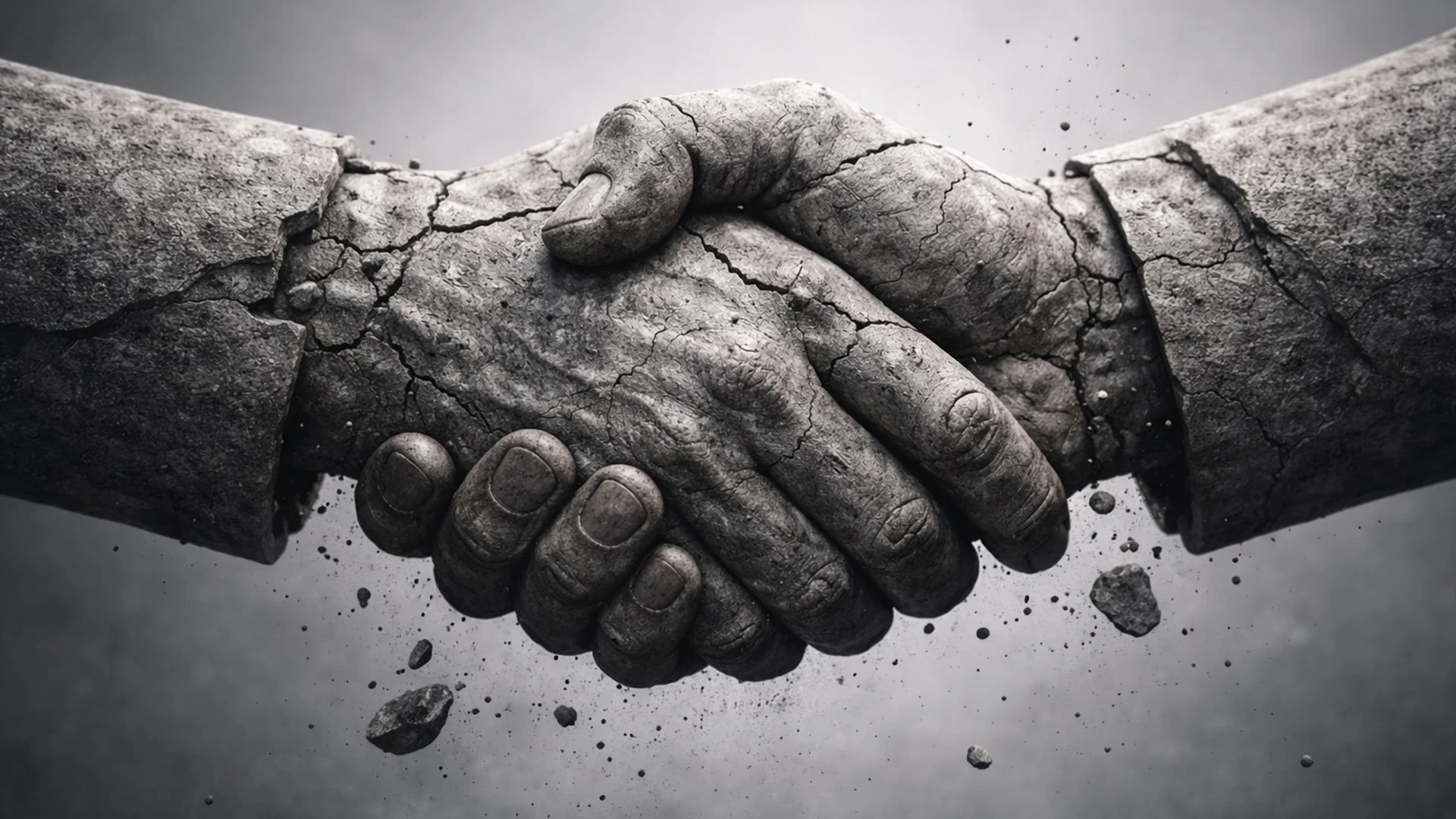
THE COLLAPSE OF TRUST WAS INEVITABLE
OPENING BRIEF
Trust didn’t fail because people suddenly became worse. That’s the convenient explanation, but it doesn’t hold up under pressure. What actually changed is the environment those people operate in.
Trust broke because speed outpaced verification.
That distinction matters more than most leaders realize. It shifts the problem from morality to mechanics. Most current conversations about trust miss this entirely. They frame the issue as bad actors, misinformation, or social decay, and then suggest the solution is better behavior or stronger values.
That framing is comfortable, but it’s wrong.
The systems we’ve built to move information, capital, and influence now operate at speeds that exceed human judgment. When information moves faster than it can be verified, belief becomes optional. Skepticism becomes rational. And in many cases, trust becomes a liability rather than an advantage.
This wasn’t a failure of character.
It was a failure of environment.
WHY TRUST EVER WORKED
Trust has never been automatic. It only functions under specific conditions, and those conditions were more fragile than they appeared.
It works when information moves slowly enough to be checked, when verification happens before consequences are triggered, and when reputation has time to form through repeated interactions. It also depends on mistakes staying relatively contained, so that failure doesn’t immediately scale into systemic damage.
For a long time, those conditions held.
Institutions had time to respond. Leaders had time to explain. Brands had time to correct. Even when something went wrong, the impact traveled at a pace that allowed for recovery.
Trust wasn’t just a social construct. It was protected by delay.
That protection no longer exists.
WHAT BROKE THE SYSTEM
The collapse didn’t come from a single change. It came from three forces hitting at once and removing the buffer that trust depended on.
(1) SPEED REMOVED THE PAUSE
Information no longer waits to be checked. It moves instantly, globally, and in most cases, permanently.
By the time facts are verified, perception has already formed. By the time clarification is issued, belief has already hardened. In many cases, the correction never catches up to the original narrative.
Trust requires a pause between signal and consequence. That pause allowed people to evaluate, verify, and adjust.
Modern systems eliminate that pause. And without it, trust has no place to operate.
(2) SCALE MADE VERIFICATION IMPOSSIBLE
Trust has always depended on proximity. Knowing who to believe requires context, familiarity, and some understanding of intent.
At scale, those signals disappear.
Leaders now operate in environments where audiences are anonymous, intent is unclear, incentives are hidden, and multiple narratives compete at the same time. There is no shared context, and no reliable way for most people to verify what they’re seeing.
In that environment, trust doesn’t fail because people become cynical. It fails because verification becomes impractical.
When you can’t verify, you default to skepticism.
(3) INCENTIVES REWARD CONFLICT, NOT ACCURACY
The systems that distribute information are not optimized for truth. They are optimized for attention.
Conflict travels faster than nuance. Certainty outperforms accuracy. Outrage consistently beats explanation. These are not occasional distortions—they are structural incentives built into the system.
When attention becomes the primary currency, the content that wins is the content that triggers reaction, not the content that reflects reality.
Trust cannot survive in an environment where the fastest, most engaging version of a story consistently outruns the most accurate one.
This is the mistake most leaders underestimate.
THE WRONG RESPONSE: “REBUILD TRUST”
When trust collapses, leaders tend to reach for familiar language. They talk about rebuilding trust, restoring confidence, and telling their story more effectively.
That response assumes trust is something you can request or earn back through communication.
It isn’t.
In a post-trust environment, appeals to trust often signal weakness. They suggest you are asking for belief rather than establishing control. Instead of stabilizing perception, they invite scrutiny and prolong uncertainty.
Trust is not rebuilt through messaging.
It is replaced through structure.
THE POST-TRUST REALITY
We are now operating in a post-trust environment, not because trust has disappeared entirely, but because it no longer functions as the primary mechanism for decision-making.
Belief has become provisional. Skepticism is the default. Silence is interpreted, often negatively. Speed punishes hesitation, and reputation is increasingly shaped externally, often before an organization has a chance to respond.
In this environment, the key question changes.
It is no longer, “Do they trust us?”
It is, “Do we control the conditions under which judgment is made?”
That is the pivot most organizations miss.
SILVER OR LEAD
The distinction becomes clearer through a simple lens.
Silver operates through influence, persuasion, and belief. Trust is a silver tool. It works when people are willing to evaluate, interpret, and eventually believe.
Lead operates through control, structure, and consequence. It does not rely on belief. It reduces ambiguity, limits interpretation, and forces outcomes that are difficult to dispute.
When belief is stable, silver works. When belief is unstable, silver becomes unreliable.
Post-trust environments don’t reward those who persuade better. They reward those who remove the need for persuasion.
Read the new book by Steve Brazell.
WHAT REPLACES TRUST
Trust doesn’t disappear without being replaced. It gets substituted by mechanisms that function under speed, scale, and pressure.
Three in particular matter.
First, controlled perception. You don’t try to convince people you’re right after the fact. You shape the frame through which judgment occurs before scrutiny begins. Once that frame is set, information tends to be interpreted within it.
Second, proof that precedes scrutiny. Evidence has to exist before questions are raised. When proof is reactive, it looks defensive. When it is proactive, it stabilizes perception early and reduces the space for doubt to expand.
Third, structure that holds under pressure. Trust often fails in moments of stress, but structure does not. Clear decision authority, defined response protocols, and disciplined communication consistently outperform reactive statements and open-ended explanations.
This is where most organizations lose control. They rely on trust in the exact moments when trust is least stable.
THE COST OF MISREADING THE MOMENT
Leaders who continue to operate as if trust can simply be restored will run into predictable problems.
They will experience accelerating reputational damage, delayed responses that appear evasive, and explanations that generate more scrutiny rather than resolving it. At the exact moment when control is required, they will lose it.
They will say, “We did everything right,” and still see negative outcomes.
Not because they were wrong in isolation, but because they misunderstood the system they were operating in.
THE ONLY QUESTION THAT MATTERS NOW
The question is no longer how to get people to trust you.
The more relevant question is how to operate when trust cannot be assumed.
That shift changes everything. It moves the focus from persuasion to structure, from messaging to control, and from belief to outcome.
Answer that correctly, and stability returns. Ignore it, and no amount of communication will compensate.
BOTTOM LINE
The collapse of trust was inevitable.
Not because people changed, but because the systems around them did. Speed removed the pause, scale removed verification, and incentives distorted what gets seen and believed.
The leaders who succeed in this environment will not be the most transparent, the most liked, or the most persuasive.
They will be the ones who understand that when trust stops functioning, clarity, control, and structure take its place.
And they will operate accordingly.