
THE DEATH OF EXPERTISE: WHEN ACCESS OUTRANKS AUTHORITY
OPENING BRIEF
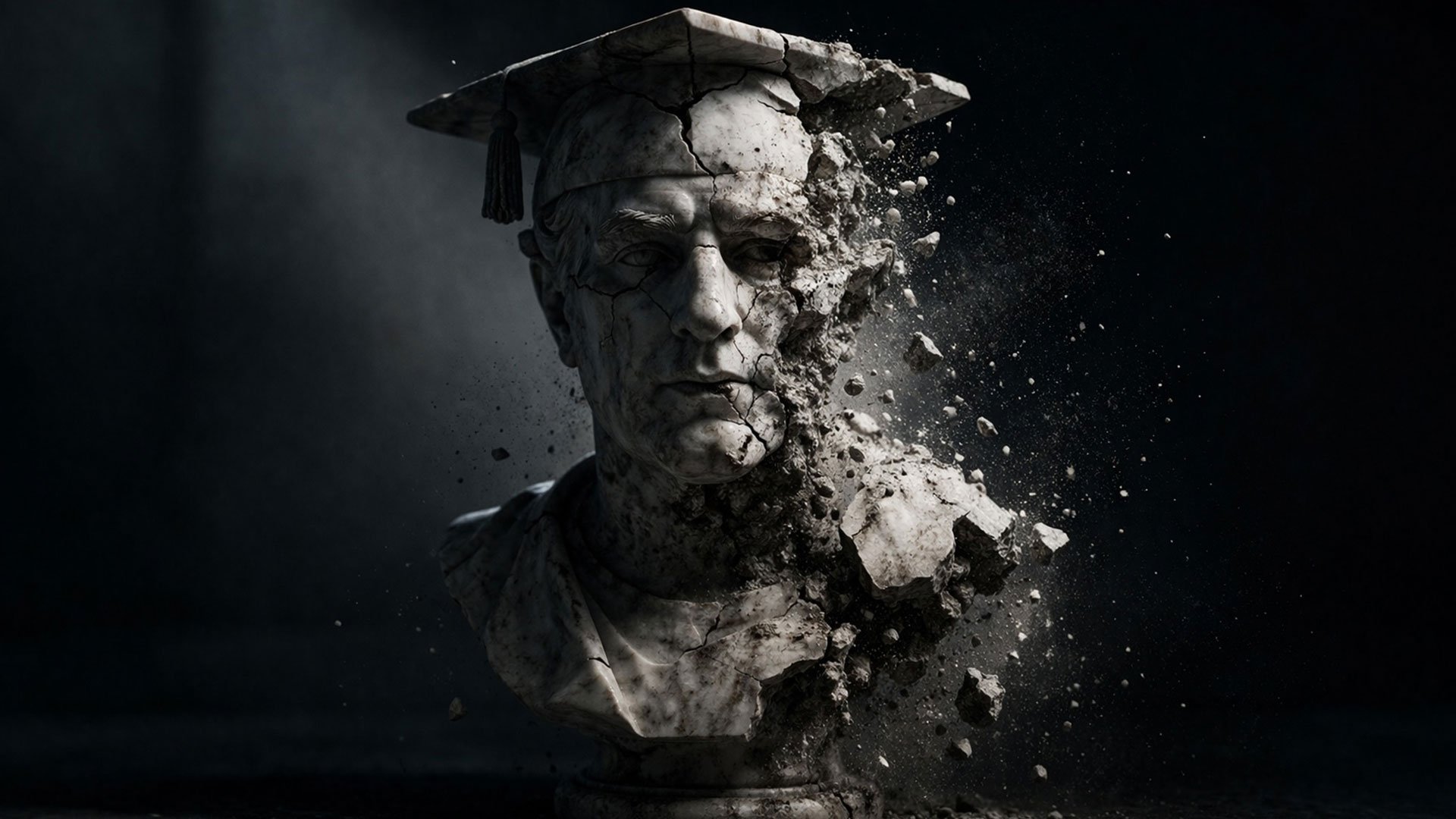
Expertise didn’t collapse because people suddenly stopped knowing things. That’s the easy explanation, and it’s wrong. What actually changed is that people no longer need permission to act like they know. Once access to information became instant and universal, the structure that protected expertise started to erode.
Most people are misreading this shift. They frame it as a decline in standards or an increase in noise, as if the solution is to elevate better experts or educate the audience. That’s comforting, but it misses the point. The system that made expertise matter has changed, and it’s not coming back.
Access replaced permission. Speed replaced depth. And confidence, whether justified or not, now consistently outperforms competence in the marketplace of attention.
WHY EXPERTISE EVER WORKED
Expertise only works under specific conditions, and those conditions were more fragile than people realized. For a long time, information was scarce, access was controlled, and participation was gated by credentials. If you wanted answers, you had to go through someone who had already been validated by an institution or a system.
Reputation also took time. You didn’t build authority overnight. It accumulated through experience, performance, and recognition, often within a relatively closed network. Mistakes stayed contained, and credibility, once established, had a degree of stability.
In that environment, expertise wasn’t just valuable. It was necessary. Not because experts were always right, but because they were the only ones positioned to provide answers. The system didn’t just reward expertise. It protected it.
WHAT BROKE THE SYSTEM
That protection collapsed under three forces that hit at the same time.
First, access destroyed permission. The internet made information available, but AI made it usable. People no longer just find answers, they can generate them, articulate them, and distribute them instantly. The need to defer to an expert has been replaced by the ability to simulate one. Whether the answer is correct becomes secondary to whether it is immediate and usable.
Second, speed outpaced depth. Verification takes time, and the current environment does not reward waiting. By the time someone with real expertise has evaluated nuance, a less informed but faster voice has already filled the space. In many cases, that first answer becomes the accepted answer, regardless of its quality. The issue is not that experts are wrong. It’s that they are late.
Third, confidence now consistently outperforms competence. Accuracy is invisible without communication, and communication that hesitates loses to communication that feels certain. Audiences are not sitting back and scoring responses based on rigor. They are reacting in real time to clarity, speed, and delivery. As a result, people who know less but speak with conviction often outperform people who know more but take time to qualify their thinking.
This isn’t a moral failure. It’s a structural shift.
THE ILLUSION OF EXPERT STATUS
One of the more dangerous assumptions right now is that expertise still translates into authority. It doesn’t, at least not automatically. Credentials still exist, experience still matters, and deep knowledge is still valuable, but none of those guarantee attention or influence anymore.
You can be right and still be ignored. You can have decades of experience and lose to someone who learned the basics last week but communicates them more clearly. That feels wrong, but it’s increasingly common.
The system no longer filters for truth first. It filters for perception. And perception forms quickly, often before any real evaluation takes place. Once that perception is set, it becomes difficult to reverse, even with better information.
THE WRONG RESPONSE: “PROVE YOU’RE THE EXPERT”
When experts feel their authority slipping, they tend to respond by doubling down on proof. They add more credentials, produce more content, and offer more detailed explanations in an attempt to re-establish credibility. On the surface, that seems logical. In practice, it often backfires.
In an environment where no one is waiting for permission, over-explaining can read as insecurity. Long defenses and delayed clarity make it seem like you’re reacting rather than leading. By the time the proof arrives, the audience has already moved on or made up its mind.
The issue isn’t that proof doesn’t matter. It’s that timing and framing matter more. Proof delivered too late looks like justification, not authority.
THE NEW REALITY
We are now operating in a post-expertise environment, not because expertise disappeared, but because it is no longer the primary mechanism through which authority is established. Authority is now assigned quickly, often before expertise has a chance to fully express itself.
Perception forms first. Evaluation, if it happens at all, comes later. Audiences decide what feels credible in seconds, and those decisions tend to stick. This creates a dynamic where attention outranks accuracy, and speed determines who gets heard.
You are no longer evaluated primarily on what you know. You are evaluated on how quickly others believe you, and whether you can translate what you know into something that feels immediately useful.
SILVER OR LEAD
This is where the distinction becomes useful. Expertise operates as a form of influence. It persuades, explains, and builds belief over time. That’s what you might call a “silver” tool. It works when the audience is willing to listen, evaluate, and trust the process.
But when belief is unstable and attention is fragmented, influence alone becomes unreliable. In those conditions, “lead” becomes more important. Lead doesn’t ask to be believed. It creates outcomes that are difficult to argue with. It reduces ambiguity instead of trying to win debates.
The shift is not away from knowledge. It’s away from relying on persuasion as the primary path to authority.
Read the new book by Steve Brazell here.
WHAT REPLACES EXPERTISE
Expertise still matters, but it no longer carries itself. It needs to be paired with three things that determine whether it actually converts into authority.
First, demonstrated outcomes matter more than credentials. What you’ve done, and what others can see you’ve done, now outweighs what you claim to know. If results are not visible, they are easy to discount.
Second, speed of application matters more than depth of analysis. The ability to take knowledge and turn it into action quickly is now more valuable than the ability to refine that knowledge indefinitely. In a fast-moving environment, delayed accuracy often loses to immediate usefulness.
Third, positioning often matters more than proof. The way an idea is framed shapes how it is received. If you control the context in which information is interpreted, you have a significant advantage. Facts still matter, but they are processed through the frame that reaches the audience first.
THE COST OF MISREADING THIS
Leaders who continue to operate as if expertise alone will carry authority are going to feel increasing friction. They will find themselves losing influence despite being more knowledgeable, moving more slowly than less qualified competitors, and struggling to be heard in environments they used to dominate.
They will hire based on credentials and wonder why execution lags. They will produce well-reasoned explanations that fail to gain traction. And they will assume the problem is the audience, rather than the system they are operating in.
Saying “we’re the most qualified” does not resolve this. In many cases, it doesn’t even register.
THE ONLY QUESTION THAT MATTERS
The question is no longer whether you are the most knowledgeable person in the room.
The question is whether you can translate what you know into something that others recognize as valuable, quickly enough to matter.
If you can’t, someone less qualified but more effective will take that position.
BOTTOM LINE
Expertise didn’t die. It lost the conditions that made it dominant.
Access removed permission. Speed removed verification. And confidence, for better or worse, now shapes perception faster than competence can catch up.
The people who win in this environment will not be the ones who simply know more. They will be the ones who can move quickly, communicate clearly, and produce outcomes that are visible before anyone asks for proof.
Everyone else will keep explaining why they’re right.
And increasingly, no one will be listening.